Performers and Composers have different perspectives on writing pieces designated for various solo instruments. While the composer maybe thinking of the structure or the philosophical meaning behind the work, the instrumentalist will be concerned with whether the part they play is possible. Is it tailormade for the instrument? Does it fit well under the hand? Are the speeds possible, given the complexity of the virtuosic cadenza, where the soloist performs a virtuosic solo?
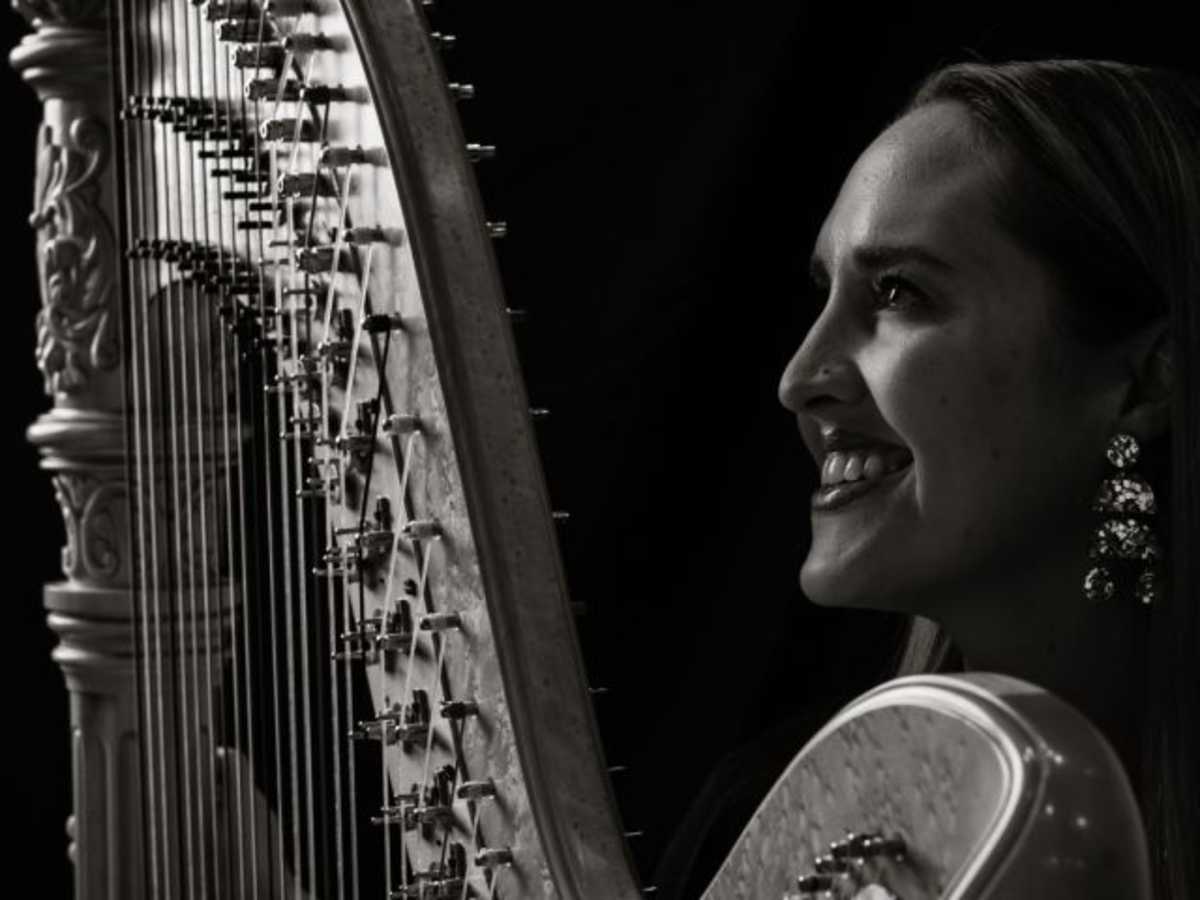
I interviewed powerhouse musical couple Emily Granger, Principal Harp from the Queensland Symphony Orchestra, and her husband the composer Tristan Coelho, about this. A special Valentine’s Day concert at Queensland Symphony Orchestra headlines Coelho’s Harp Concerto, written for and gifted to Granger.
For my full review of QSO Portraits, written for Limelight, go here.
Interview with Emily Granger on performing Tristan Coelho’s harp concerto
We begin with Emily’s interview.
What present has Tristan given you in the past for Valentine’s Day?
Flowers from Woolies sometimes but we are more big gesture people and go for experiences and big trips. For his fortieth I commissioned three pieces for harp by three Sydney Composers Holly Harrison, Mark Oliveiro and Alex Pozniak and gave a recital of them on his birthday.
Is there a special spot in the concerto which you especially love that the audience can listen out for?
There are many but I’m very fond of the final coda of the fourth movement. It’s like the disco ball drops and we’re all having a great time dancing on the dance floor, a moment of pure joy.’
Did you give Tristan advice to ensure the concerto is harpcentric and playable?
Yes and no. For ten years we’ve worked together. I let him write what he wants and then I go over it with a fine toothcomb to ensure it’s possible on the harp. There was one measure with 9 pedal changes!
We worked through it. I definitely want his creative juices to flow first and then we workshop possibilities together.
What’s it like playing solo with the QSO?
My colleagues welcomed it with open arms. The concerto’s composed with the QSO in mind and there are opportunities for other players to shine for instance Phoebe Russell the Principal Bass, Irit Silver, Principal Clarinet, the concertmaster Natsuko Yoshimoto and Nick Mooney Principal Horn. The harp is often interwoven with the orchestral textures.
What kind of language?
Definitely dissonance with the crunch of cluster chords but there also numerous melodic stretches throughout the piece. Second movement has some beautiful tunes and in the third, the ostinato patterns have immense appeal.
Tristan Coelho on his harp concerto
Then I spoke to the composer Tristan Coelho about his harp concerto.
Tell me about the harp concerto? What is it about? Does it reference anything in particular?
Look, it’s a big work. It comes in at 30 minutes, and its genesis is my ten-year collaboration with Emily. Each movement is a journey through different imagined landscapes. The first movement Monoliths is inspired by the granite land forms at Yosemite known as monoliths. Orchestral passages represent the epic monoliths and sets the harp in a tussle with the ensemble. I was interested in putting the harp into different contexts. Rather than the cliched angelic, light and fragile productions harps are associated with I was thinking of the instrument as a warrior doing battle with the orchestra.
How does it differ from, say, a 19th century showy concerto?
It’s hard to get away from the practical reality you are pitting a soloist against an orchestra. I’ve always been deeply moved by Rachmaninov’s Second Piano Concerto. Romantic composers were obsessed with the natural world which was a source of inspiration. In my concerto I wanted to represent the visual landscape through the music and it’s in four movements whereas the great concertos from the 19th centuries commonly have three.
What kind of language do you use?
It breaks into challenging harmonic worlds and doesn’t shy away from extended instrumental techniques or wilder orchestral timbres. It has a massive emotional and environmental template.
I admire the American composer John Luther Adams. Love his large scale uncompromising, majestical and lyrical works. Toro Takemitsu is also a source of inspiration. His music is worlds apart from Adams because it’s contemplative, wispy, hazy.
Why do you think audiences will enjoy it?
Most would enjoy the depth and breadth and expression in the piece. Any good composition is transportive and it can surprise and shock us. There are huge contrasts. The opening is big and intense and is about the harp breaking through the maelstrom of sound. The second movement is delicate and tranquil. Every movement is a discrete and has a different emotional arch.
History of the musical gift from composers to their loved ones
Tristan is following in the footsteps of some hefty composers including:
- Richard Strauss: Dedicated his Four Songs, Op. 27 (1894), including the famous Morgen!, to his wife, soprano Pauline de Ahna, as a wedding gift.
- Gustav Mahler: Composed the Adagietto from his Symphony No. 5 as a love letter to his wife, Alma Mahler. He also wrote Liebst Du Um Schönheit for her.
- Richard Wagner: Secretly composed the Siegfried Idyll (1870) as a Christmas/birthday gift for his wife, Cosima.
- Robert and Clara Schumann: Dedicated many works to each other, notably Liebesfrühling (Love Spring). Robert's music was heavily inspired by his marriage to Clara.
- Benjamin Britten: Composed the Seven Sonnets of Michelangelo (1940) for his partner, tenor Peter Pears.
- Edvard Grieg: Wrote Wedding Day at Troldhaugen (1892) for his wife, Nina Hagerup Grieg.
- Edward Elgar: Wrote Salut d'Amour (Love's Greeting) as an engagement present for his wife, Caroline Alice Roberts.
- Johann Sebastian Bach: Wrote pieces for his second wife, including the Notebook for Anna Magdalena Bach.
- Béla Bartók: Composed his Piano Concerto No. 3 (1945) for his wife, Ditta Pásztory-Bartók, as a birthday present and to provide her with future income.
- Hector Berlioz: Wrote Symphonie fantastique inspired by his infatuation with actress Harriet Smithson.
- Ludwig van Beethoven: Although he never married, he wrote music for his "distant beloved" (unseen love), such as An die ferne Geliebte.
- César Franck: Wrote his Violin Sonata as a wedding gift for violinist Eugène Ysaÿe.
Thank you, Emily Granger and Tristan Coelho, for speaking with me for this fascinating insight.
Would you like to get my monthly updates in your inbox? Sign up for my newsletter here, and get the first chapters of my book, Big Music.